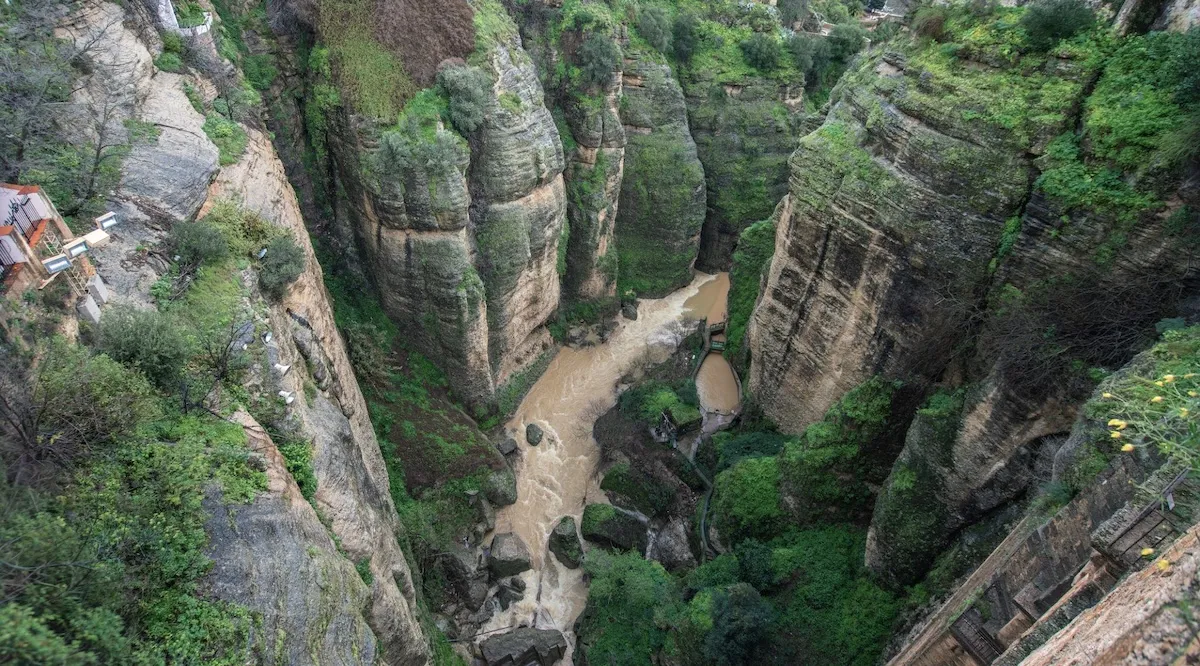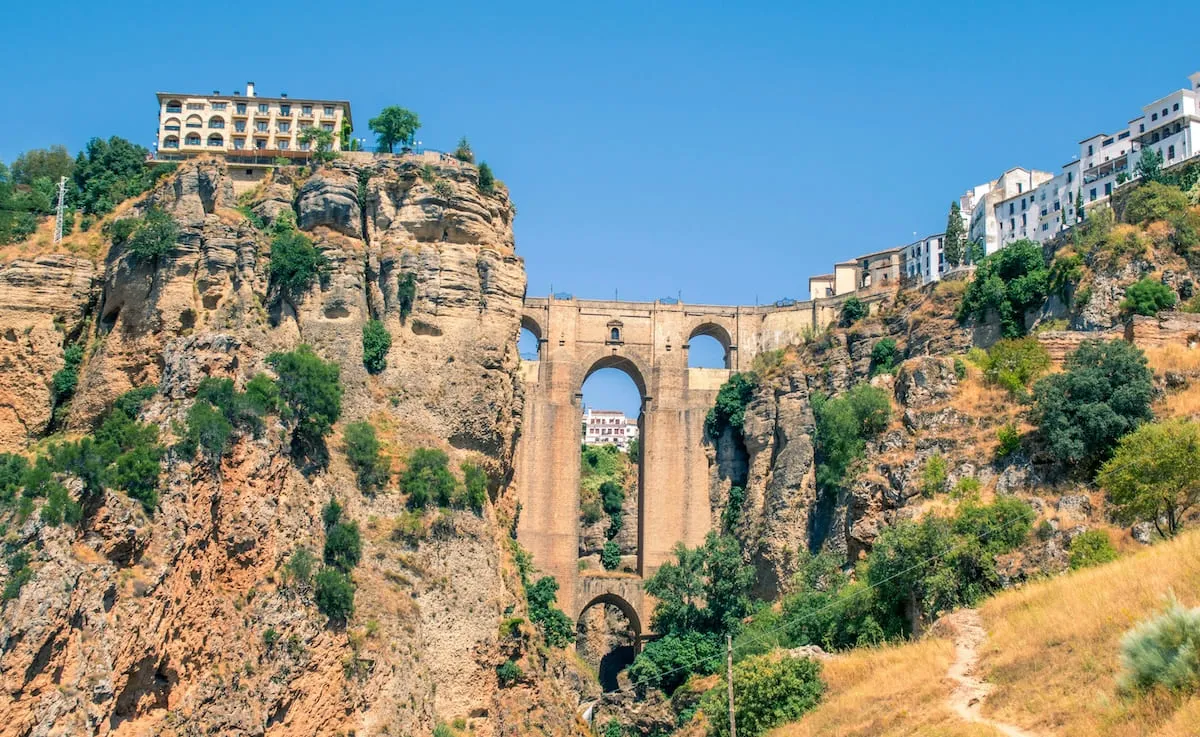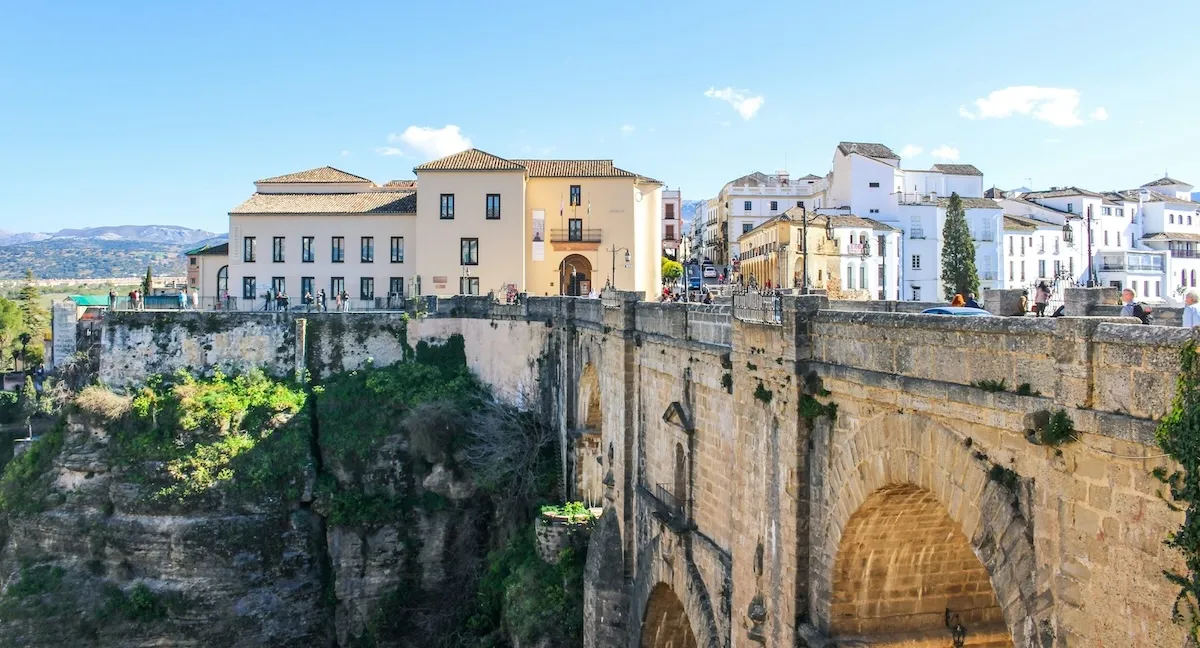
Stand in the middle of the Puente Nuevo and look over the parapet. The río Guadalevín runs roughly 98 metres below, at the bottom of the gorge everyone here calls El Tajo. The bridge joins the two halves of town: La Ciudad, the old Moorish medina that surrendered to Castilian troops in 1485, and El Mercadillo, the district merchants built outside its walls from that same year.
Prices below are 2026 rates. Opening times are the winter timetable that applies from October; in summer, most municipal sites stay open an hour later on weekdays.
1. Puente Nuevo and its interpretation centre
Crossing the bridge is free, at any hour. Inside it, a small interpretation centre tells how it was built between 1751 and 1793, finished by the architect José Martín de Aldehuela. The chamber above the central arch was once a prison, and you enter it from Plaza de España.
There is a catch: from the bridge, you cannot see the bridge. You see the drop, the cliffs and the plain beyond, but the arch itself stays under your feet. For the classic view, you need a viewpoint or a path down, both covered below.
Do not pay for the interpretation centre on its own: it is part of the municipal bono described further down.
- Price: bridge free; interpretation centre €2.50, free for under-8s.
- Hours: Tuesday to Friday 9:30 to 19:00; Monday and Saturday 10:00 to 14:00 and 15:00 to 18:00; Sundays and holidays 10:00 to 15:00. Last entry half an hour before closing.
2. The viewpoints, all free
The Mirador de Aldehuela sits on a rocky terrace at the eastern end of the bridge, between the bridge and the Convento de Santo Domingo. It is almost flat, a few minutes from Plaza de España, and the easiest option with a pushchair or limited mobility. Opposite, the Jardines de Cuenca give a similar view of the bridge and the gorge with fewer people around.
On the Mercadillo side, the Alameda del Tajo is a 19th-century garden that ends at a sheer drop of about 100 metres over the valley. Its main balcony has a nickname that locals will happily tell you, taken from the swear word the drop tends to pull out of visitors. Come for the sunset over the valley, not for the bridge: the classic view of it is elsewhere.
To see the Puente Nuevo whole, from top to bottom, you have to go down. The Camino de los Molinos starts at Plaza de María Auxiliadora and zigzags towards the floor of the gorge, down to the Arco del Cristo, which frames the bridge from below. The platform at the foot of the bridge, the Mirador del Puente Nuevo, is now part of the paid walkway described below. Ten to fifteen minutes further, the Mirador de la Hoya del Tajo shows the bridge, the cliffs and the town together. ¡Ojo!: the way back is steep and takes about twice as long as the way down.
- Price: free.
- Best light: morning at Aldehuela and Jardines de Cuenca; late afternoon on the Camino de los Molinos.
3. Desfiladero del Tajo, the walkway inside the gorge
Since September 2026, a path and a series of walkways run along the Guadalevín at the bottom of the gorge, right under the Puente Nuevo. The entrance is about 180 metres from Plaza de María Auxiliadora, and the route ends near the Baños Árabes.
Down there, the scale changes. The rock walls rise on both sides, the river runs beside you, and the bridge you crossed an hour earlier appears high above your head.
This is the one paid sight we would not skip. Book a slot in advance: places are limited, and the rules exclude children under 8, wheelchairs and pushchairs.
- Price: €12, booked on turismoderonda.es.
- Hours: winter 9:00 to 17:00; spring and autumn 10:00 to 20:00; summer 10:00 to 14:00 and 18:00 to 21:00.
4. Plaza de Toros and the bullring museum
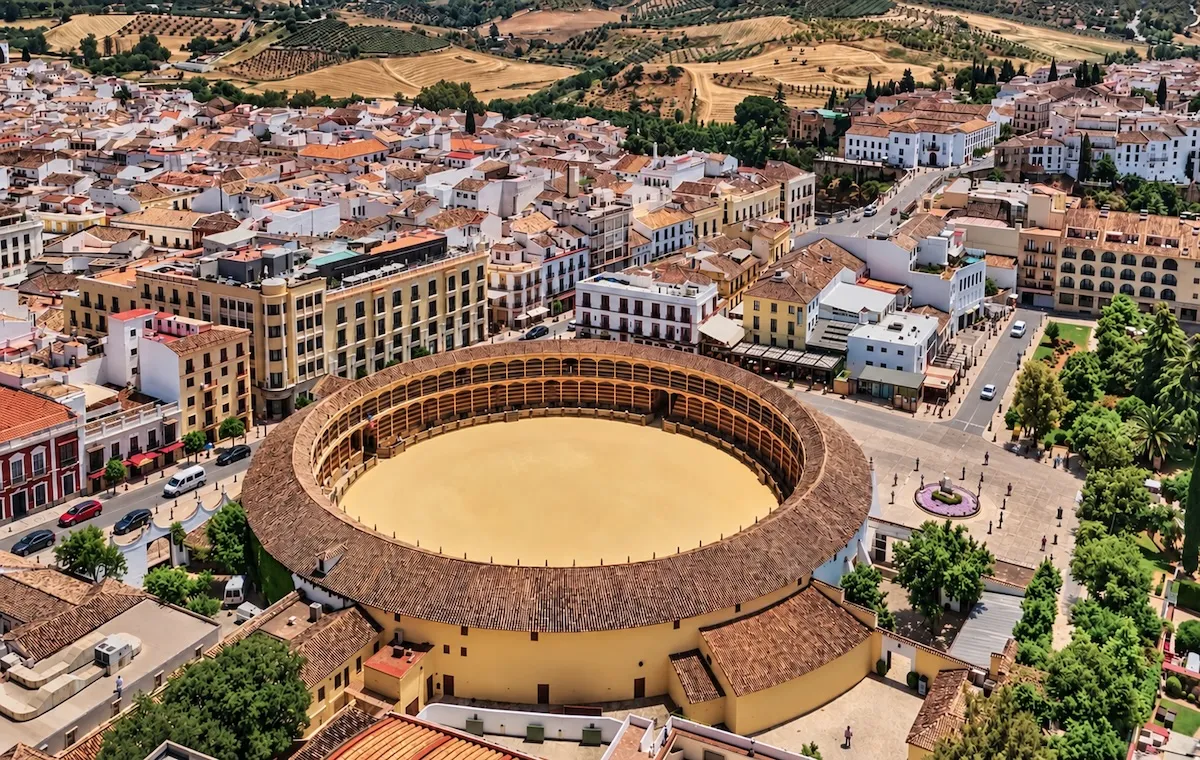
The bullring of the Real Maestranza de Caballería dates from 1785 and is considered a sanctuary of bullfighting on foot. The ticket covers the stands, the arena floor and the museum on the institution's history.
On a weekday, the empty ring under its stone arcades is unexpectedly quiet. After two years of consolidation works, during which visits never stopped, it reopened for bullfights in September 2026.
Check the date if you come in early September: the ring closes to visitors on bullfight days, including the Corrida Goyesca of the Pedro Romero fair.
- Price: €10, or €12 with audio guide.
- Hours: daily; 10:00 to 19:00 in March and October, 10:00 to 18:00 from November to February, 10:00 to 20:00 from April to September.
5. Casa del Rey Moro: gardens and water mine
Calle Santo Domingo 9 hides two things: terraced gardens designed in 1912 by the French landscape architect Jean-Claude Nicolas Forestier, and a 14th-century water mine cut into the side of the gorge. More than 200 steps, narrow and often damp, lead down through the rock towards the river.
The house itself, in neo-Mudéjar style, is closed for restoration. That is our reservation: €10 buys the gardens and a long staircase, and several recent visitors felt it was too much. If you are fit and curious about the mine, go. If stairs are a problem, skip it.
Arrive at 10:00, when it opens, to have the gardens and the mine before the crowds.
- Price: €10; €3 for children under 12.
- Hours: daily, 10:00 to 21:00.
- Allow: 60 to 90 minutes. The mine is not suitable for visitors with reduced mobility.
6. Baños Árabes
On Calle San Miguel, the Arab baths date from the 13th and 14th centuries and are among the best preserved in the Iberian Peninsula. The visit takes about 30 minutes.
They sit close to the exit of the Desfiladero del Tajo, so the two fit well in the same morning. Entry is included in the municipal bono.
- Price: €4.50; €3 reduced (students under 26, retired people).
- Hours: Tuesday to Friday 9:30 to 19:00; Monday and Saturday 10:00 to 14:00 and 15:00 to 18:00; Sundays and holidays 10:00 to 15:00.
7. Palacio de Mondragón
The municipal museum occupies a palace built between the 16th and 18th centuries, where Mudéjar and Renaissance styles meet around patios and gardens. The exhibition runs over two floors, in chronological and thematic order.
Come for the patios as much as for the collections. It is also covered by the bono.
- Price: €5; €3.50 reduced.
- Hours: same as the Baños Árabes.
8. Iglesia de Santa María la Mayor
The main church of La Ciudad stands on the site of the town's former main mosque. It was built in the time of the Catholic Monarchs, in the 15th century, and still keeps the arch of the 13th-century mihrab.
Look for the mihrab arch during the visit: it is the clearest trace of the mosque. The ticket includes an audio guide.
- Price: €4.50 with audio guide.
- Hours: Monday to Saturday 10:00 to 19:00; Sunday 10:00 to 12:30 and 14:00 to 19:00.
9. Museo Lara
A private collection in a palace on Calle Armiñán: clocks, weapons, cinema and photography, a romantic museum, and rooms on the Inquisition and witchcraft. It is an odd mix.
At €4 it is the cheapest of the paid sights, and a good fallback if the weather turns.
- Price: €4.
- Hours: daily, 11:00 to 19:00.
The bono turístico: when it pays off
The municipal bono costs €12 (€9 for groups, retired people and students under 26). It covers the Puente Nuevo interpretation centre, the Casa del Gigante, the Baños Árabes and the Palacio de Mondragón, plus the Convento de Santo Domingo and the Museo Joaquín Peinado when available. Each site can be visited once.
The maths is simple. The interpretation centre, the baths and the palace already add up to €12 at full price, so the Casa del Gigante comes free. If you plan to see two of them or fewer, pay at the door. Late in the day, the "Diseña tu bono" option gives three municipal sites for €6.50 in the two hours before closing.
- Where to buy: the tourist office on Paseo Blas Infante, or turismoderonda.es.
How long to stay: half a day to three days
With half a day, stick to the Puente Nuevo, the viewpoints around it and a walk through La Ciudad. It gives a fair idea of the town.
With a full day, add the interiors: the Casa del Rey Moro in the morning, the Baños Árabes and Santa María la Mayor, then the walk down the Camino de los Molinos in the late afternoon. For lunch between two visits, see our selection of restaurants in Ronda.
Two or three days leave room for the Desfiladero del Tajo, the bullring and an evening paseo along the Alameda del Tajo. Use the extra day for the surroundings: Setenil de las Bodegas, the village built under overhanging rock, is 20 to 30 minutes by car, with buses from Ronda on weekdays only. The Cueva de la Pileta, near Benaoján, holds Palaeolithic rock art and can only be visited with a guide.
Getting to Ronda
Since 7 September 2026, no trains run to Ronda: the line is closed for works until the autumn of 2027, with Renfe replacement coaches from Antequera-Santa Ana. Come by bus or by car. If you drive, park once and walk: the centre is compact and steep.
- From Málaga: about eight buses a day, 1h30 to 2h30 depending on stops; about 1h30 by car. Details in our guide from Malaga to Ronda.
- From Seville: direct Damas bus, about 2 hours, four a day. Details in our guide from Seville to Ronda.
- Parking: the Martínez Astein underground car park, near the train station, as the Plaza del Socorro car park has been closed since late August 2026. More options in our guide to parking in Ronda.
- Tourist office: Paseo Blas Infante, +34 952 18 71 19. Guided tours in Spanish leave from here, Monday to Saturday (€10).
Frequently asked questions
Can you visit Ronda as a day trip from Málaga or Seville?
Yes. From Málaga, buses take 1h30 to 2h30 and there are about eight a day; take an early one out and book the return at the same time, as there are only a few evening services back. From Seville, the direct Damas bus takes about 2 hours: leaving around 09:00 and returning on the last bus at 18:30 gives you about seven and a half hours in Ronda, enough for the bridge, the viewpoints and a couple of interiors.
What is the best time of year to visit Ronda?
Spring (April and May) and early autumn (September and October), when it is mild enough to walk the town and the paths down into the gorge. Summer is hot and dry, with August the hottest month, so do your sightseeing early in the morning or late in the afternoon. Winter is quieter, but January is cold and nights can be very cold.
Is Ronda suitable for visitors with reduced mobility?
Partly. The town is steep, but the Puente Nuevo and the Mirador de Aldehuela are almost flat. The bullring is accessible, the Museo Lara on its ground floor, and Santa María la Mayor if you let them know in advance. The Casa del Rey Moro water mine, the Camino de los Molinos and the Desfiladero del Tajo are not suitable: they involve long, steep stairs or paths, and the Desfiladero does not admit wheelchairs.