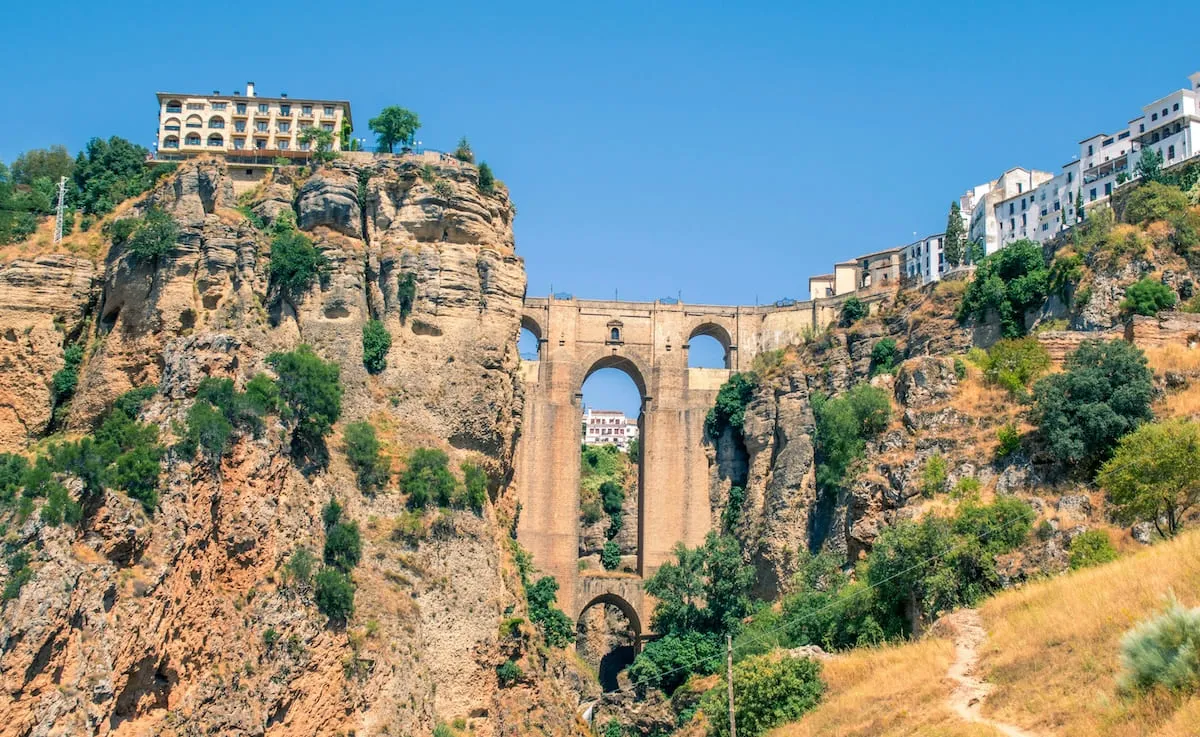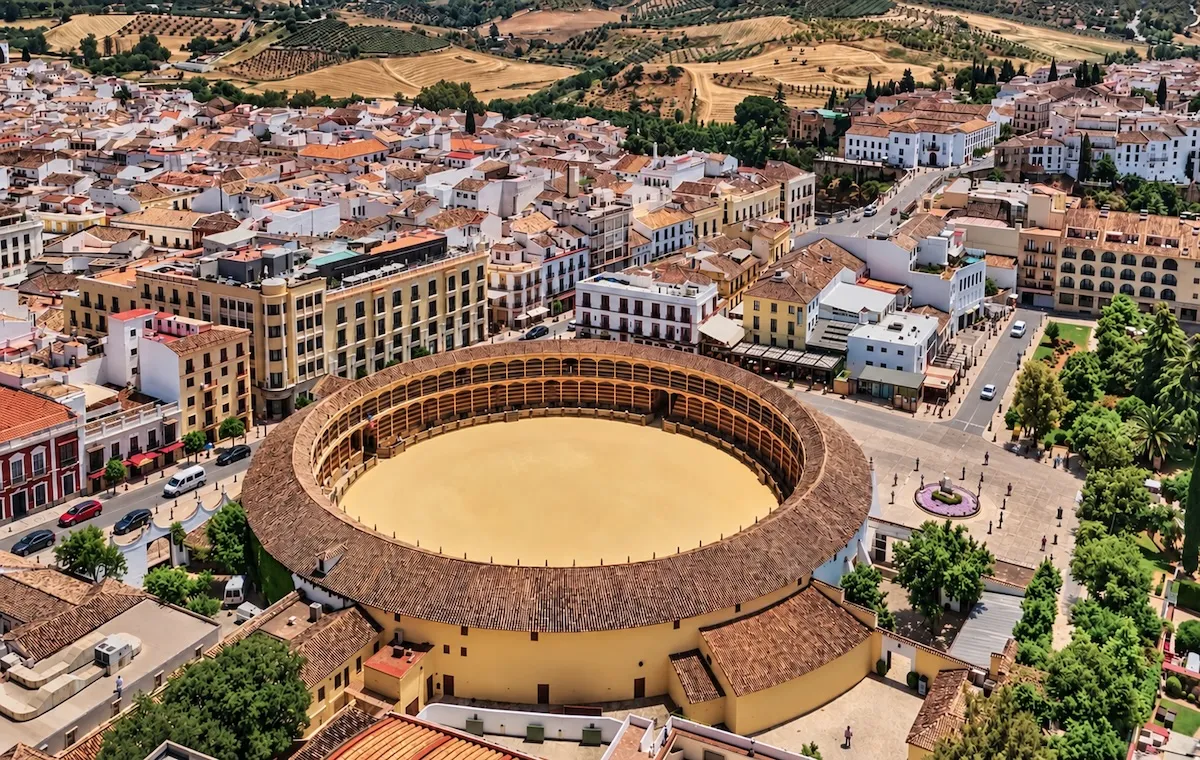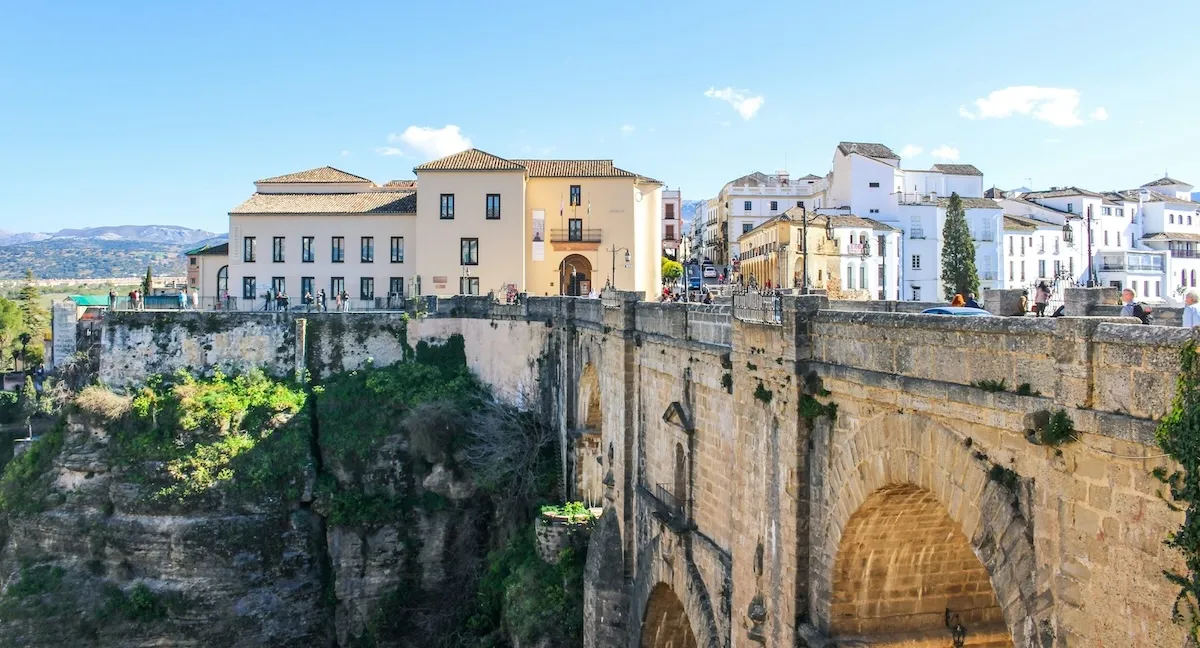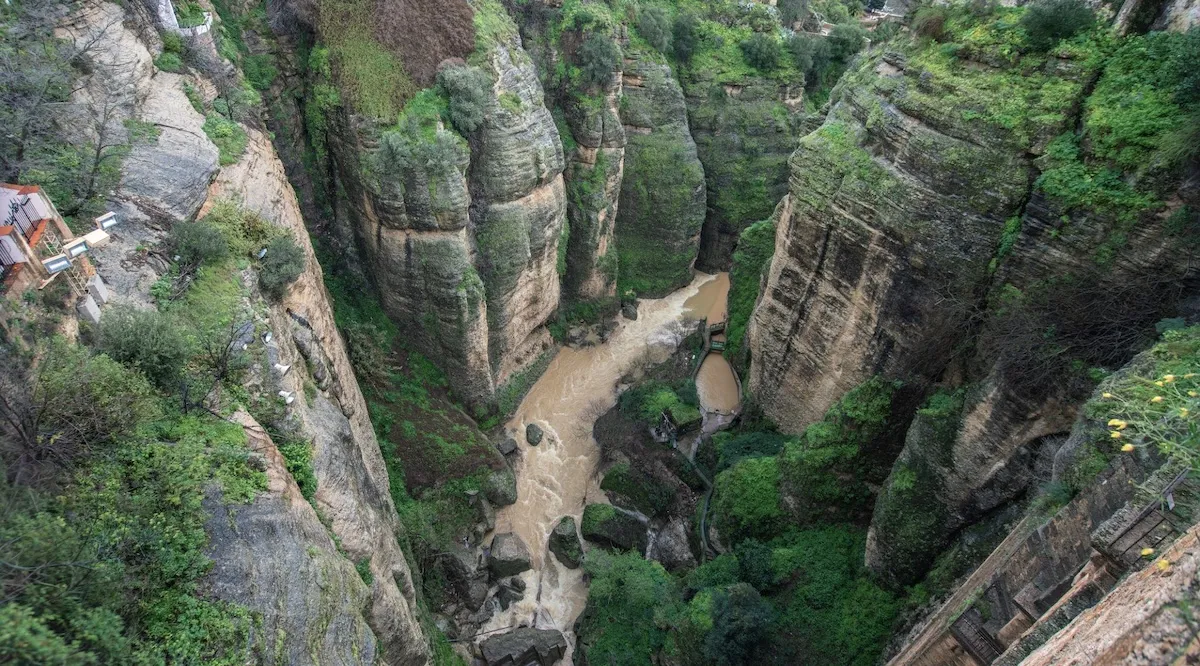
El Tajo splits Ronda in two. On one side is La Ciudad, the old Moorish town; on the other, El Mercadillo, the district merchants built outside its walls. Between them, the río Guadalevín has cut a gorge 500 metres long, about 100 metres deep and 50 metres wide, according to the Junta de Andalucía. In Spanish, a tajo is a clean cut, and that is exactly what it looks like from above.
For the bridge, its history and the best spots to photograph it, see our guide to the Puente Nuevo. This one is about the gorge underneath.
When Ronda was a bay
The walls of the Tajo are made of conglomerate laid down by an old delta in the Miocene, when the sea covered part of the region and rivers emptied into it. The layers get finer and thinner towards the top, a sign that the sea was gaining ground on the rivers. The IGME, Spain's geological survey, sums up the story of the last nine million years in a phrase used for a 2016 geology day: cuando Ronda era bahía, when Ronda was a bay.
The gorge came much later. The Guadalevín cut down through these layers over thousands of years, and at the foot of the cliffs the gorge opens onto a circular basin known as La Caldera.
A natural monument with residents
The Junta de Andalucía declared El Tajo a Monumento Natural on 23 April 2019. The protected area covers 28 hectares, including a buffer zone, and part of it belongs to the river Guadalevín's European conservation area. It sits right in the middle of the town.
The cliffs are busy. A large colony of lesser kestrels, a small falcon, nests in the rock walls, and the Junta also lists choughs, peregrine falcons, eagle owls and swifts.
Bring binoculars if you have them.
Inside the gorge: the Desfiladero del Tajo
Since 15 September 2026, a path and a series of walkways run along the Guadalevín for almost a kilometre, from Plaza de María Auxiliadora to the Padre Jesús district, next to the Baños Árabes. The first section, open since April 2024, reaches the foot of the Puente Nuevo; the second follows the river on a 500-metre walkway.
Down there, you see what the viewpoints cannot show: the height of the walls on both sides, the layers of rock, and the river running beside you. This is the paid visit we would choose first in Ronda. Leave the tripod at the hotel: drones and tripods are banned, and so are bulky rucksacks, animals and children under 8.
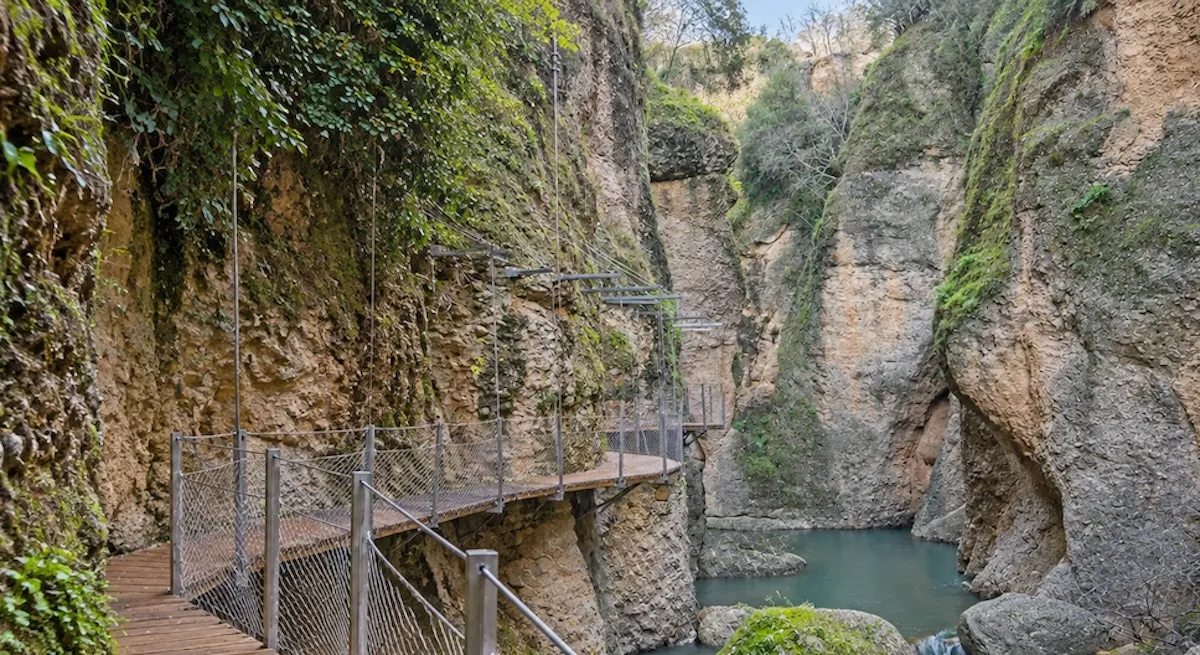
- Price: €12, free for Ronda residents. Book a time slot on turismoderonda.es.
- Hours: winter 9:00 to 17:00; spring and autumn 10:00 to 20:00; summer 10:00 to 14:00 and 18:00 to 21:00.
Through the rock: the Casa del Rey Moro water mine
The other way down is older. At Calle Santo Domingo 9, a 14th-century water mine is cut into the side of the gorge, and more than 200 narrow, often damp steps lead down through the rock towards the river. Above it, terraced gardens designed in 1912 by the French landscape architect Jean-Claude Nicolas Forestier look over the Tajo.
The house itself is closed for restoration, so €10 buys the gardens and the staircase. Several recent visitors felt that was too much. If you are fit and curious about the mine, go; if stairs are a problem, skip it. ¡Ojo!: every step down is a step you climb back up.
- Price: €10; €3 for children under 12.
- Hours: daily, 10:00 to 21:00.
- Allow: 60 to 90 minutes. Not suitable for visitors with reduced mobility.
Along the edge
You do not need a ticket to feel the drop. The Alameda del Tajo, a 19th-century garden on the Mercadillo side, ends at a sheer cliff of about 100 metres over the valley, and it is the place to be at sunset. The Catalonia Reina Victoria, where the poet Rainer Maria Rilke once lived, and the Hotel Montelirio, a 17th-century palace, both stand on the edge of the gorge; they are in our selection of hotels in Ronda.
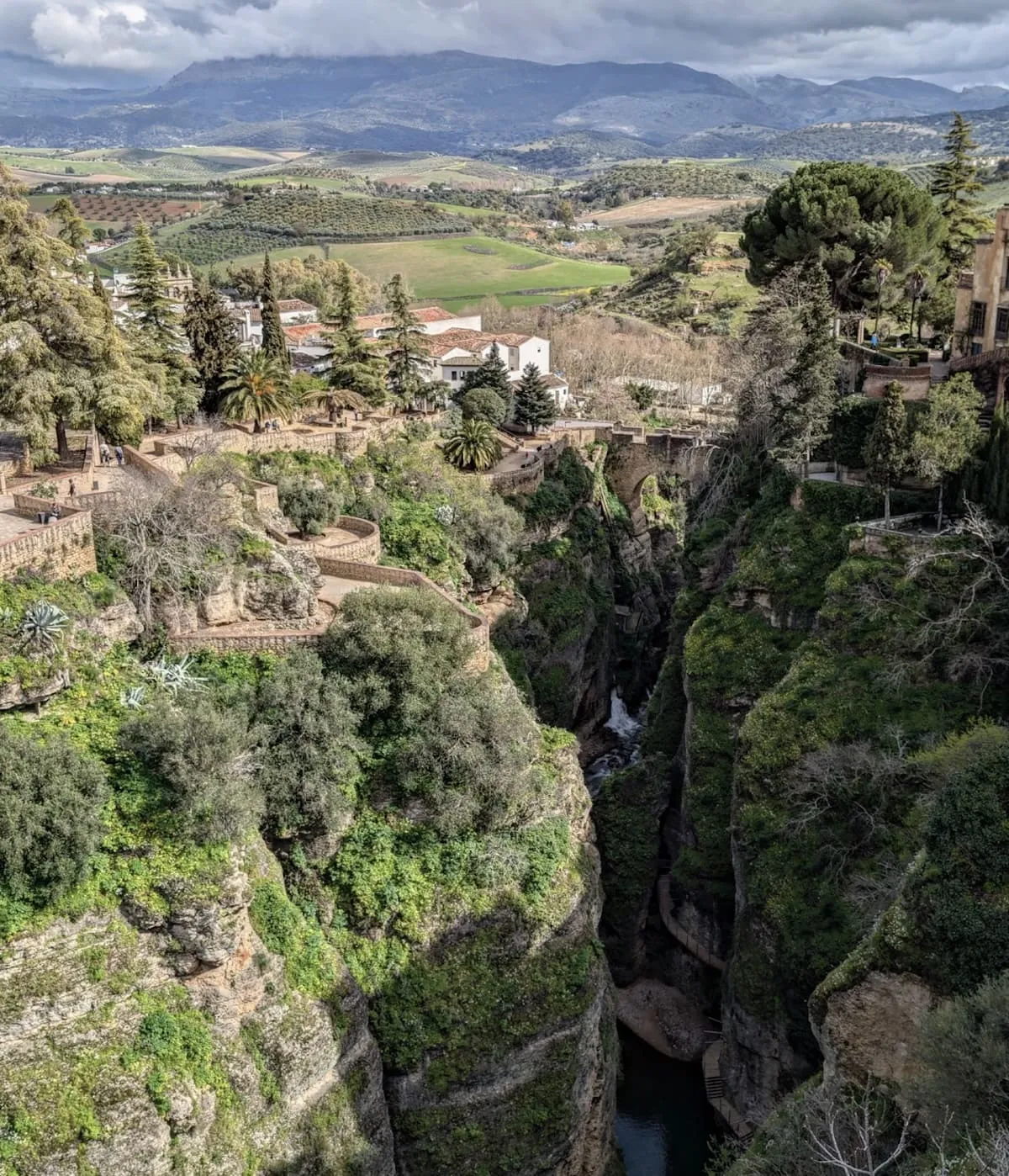
At the bottom of the old town, the Puente Viejo, built in the 17th century, crosses the Guadalevín near the Baños Árabes. It is the natural end point of the Desfiladero walk.
A half day in the Tajo
Start at 10:00 at the Casa del Rey Moro, when it opens and before the crowds, and go down the mine. Book an afternoon slot on the Desfiladero, walk the floor of the gorge, and come out near the Baños Árabes and the Puente Viejo. Finish at the Alameda del Tajo for the sunset.
If you prefer to stay free of charge, the Camino de los Molinos, from Plaza de María Auxiliadora, goes down the slope below the cliffs to the Arco del Cristo; the details are in our Puente Nuevo guide. For everything else in town, see what to see in Ronda.
Frequently asked questions
How deep is El Tajo de Ronda?
About 100 metres, according to the Junta de Andalucía, for a length of 500 metres and a width of 50. Under the Puente Nuevo, the river runs about 98 metres below the bridge.
Can you walk at the bottom of the Tajo gorge?
Yes. Since 15 September 2026, the Desfiladero del Tajo walkway follows the river for almost a kilometre, from Plaza de María Auxiliadora to the Baños Árabes. It costs €12, free for Ronda residents, you need to book a time slot, and children under 8 are not allowed. For a free view from below, the Camino de los Molinos goes down the slope to the Arco del Cristo.
Is the Casa del Rey Moro water mine worth it?
Only if you like stairs. €10 gets you the gardens and the 14th-century mine, with more than 200 narrow, often damp steps down through the rock and the same climb back up; the house itself is closed for restoration. Several recent visitors found it too expensive. If you go, arrive at 10:00, when it opens.